
Episode conversation
The Most Oregon Conversation We've Ever Had
A conversation about finding the right Oregon community, understanding the housing choices around Corvallis, and building trusted local relationships.
Real estate is personal
When a property decision carries more than a price
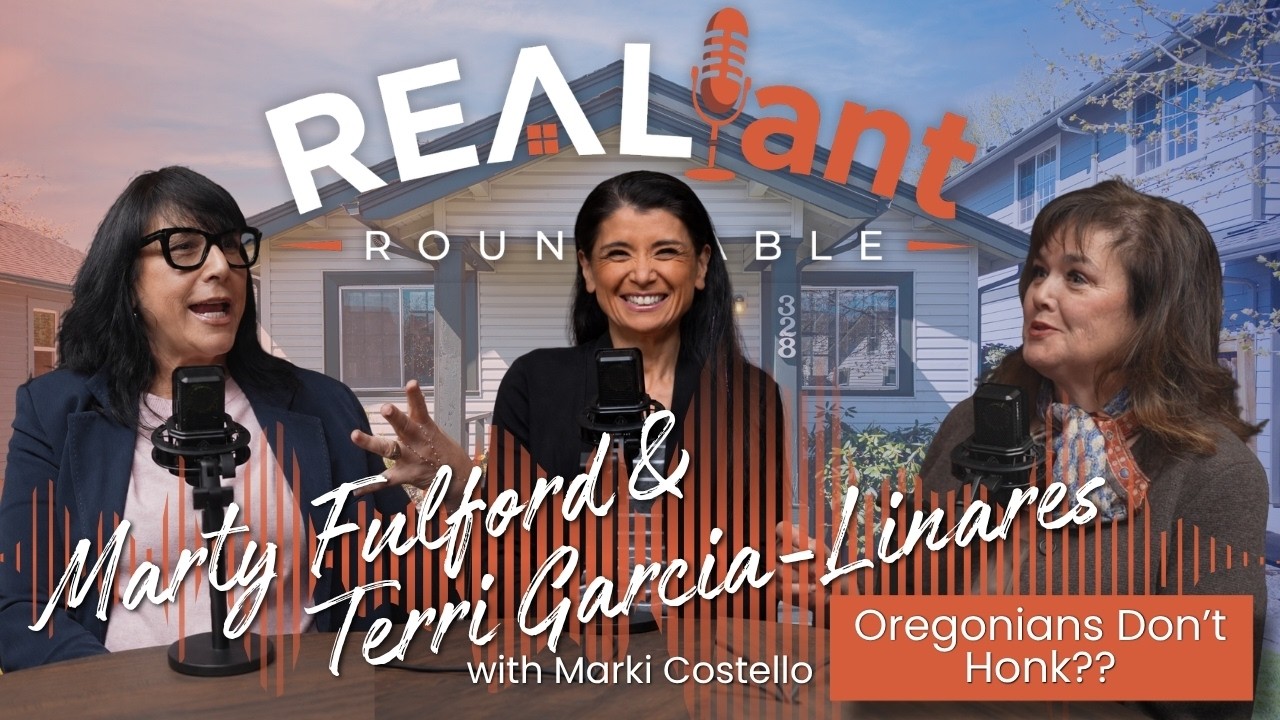
Choosing a home is also a choice about community, pace, landscape, and the people who help make a move possible. In this Realiant Roundtable conversation, Marty Fulford and Terri Garcia-Linares explore the housing choices around Corvallis, what newcomers should understand about Oregon life, and why trusted local relationships matter throughout a transaction.
Market statistics cannot explain whether someone will feel at home in a particular neighborhood or town. Buyers still need to consider daily routines, weather, recreation, financing, property type, and the character of the community before deciding what fits.
The right move begins with understanding how someone wants to live, not just which properties happen to be available.
Watch or read
The complete conversation
The complete episode covers Corvallis and nearby communities, relocation, retirement, college-town housing, development, lending, Oregon weather, and the local habits that make the state feel distinctive.
Prefer to read? Open the complete lightly edited read-along below the video.
Read along with the episode
Marki Costello: Welcome to Realiant Roundtable, where real estate meets the stories that shape a community. Today we’re sitting down with Marty Fulford, principal broker with Connected Real Estate Group, and mortgage pro Terri Garcia-Linares of Union Home Mortgage. How are you? Between the two of you bring over what, 20 years? 30 years of experience?
Marty Fulford: Between the two of us, probably 40 years.
Marki: 40. Whoa, I love that. So in real estate and mortgage lending, giving us a real 360 view of the housing market in Oregon, right? On this episode, we’re gonna talk about what people are really looking for in today’s market, how Oregon communities are evolving, and why great real estate is never just about property, it’s about timing, trust, and knowing where the next chapter begins.
Marki: This is Realiant Roundtable. Ladies, welcome to the pod.
Terri Garcia-Linares: We are happy to be here.
Marki: Marty, tell. I know every realtor has sort of their own little brand within real estate. What would you say your brand is?
Marty: Because it’s not about helping people buy or sell, it’s about helping people be comfortable in knowing that they’ve made the right decision, that they’re in the right place that’s for them. And when they move here, right, then connecting them with others that can help support and love them.
Marki: This being a college town, Corvallis specifically. And I know you sell in Albany and surrounding areas, what are we seeing? Who’s buying? Is it professors? Is it parents of students that say, "We don’t wanna waste money on rent. We wanna buy something for the next four years that can be an investment.
Marki: Then if they decide to go to grad school in New York, we could then rent it to the next group of college students coming in." What do you. Explain to me the Corvallis real estate market, ladies.
Marty: Do you wanna go first?
Terri: I have all those scenarios right now. I have people relocating for jobs at the university, people who are upgrading ’cause their house is too small that have been here for years and years and years. And then I also have those, right now, somebody who’s purchasing for their child who is going to Oregon State and wants an investment property. I have, a little bit of everything right now.
Marty: A lot of people come to retire. So Corvallis is the second most educated or city in the nation, right? And so, a lot of that is due to the university. It’s also due to the hospital structure and the culture that’s around here. And so, yeah, we have a strong retirement community.
Marki: Someone that was w-, listening and watching this right now, that was thinking about like, "I would love a second home, and I love Oregon." It’s a hop, skip, and a jump from a lot of Californians. Oregonians hate that, because when I first moved here and I had my California license plate, people would follow me downtown and I’d be like, "Why is that guy flipping me off?"
Marki: Then later I had to go to the DMV, and I had to become with Oregon, because then people are a lot nicer. I fly out of Eugene all the time. It’s the best-kept secret. Well, maybe it’s not a secret, but it’s the best airport in the world. If you have an 8:00 AM flight, you can literally pull up at, 7:35.
Marki: You’re through security in six seconds, and they’re so lovely. And I mean, it is the best airport. In the world, people. Sorry. A lot of Californians come here because it is such a hop, skip and a. It’s so close, and it’s beautiful. What would you say to someone that said, "Hey, I wanna get a second home in Oregon."
Marki: How would you sell them on Corvallis if they were a younger couple and not into the retirement aspect of their life, not a student anymore, sort of in between. Would you say to them? What are the questions you ask to kinda see what kind of community they would wanna fit in here?
Marty: It depends on the interest, right? What are people interested in? Are they coastal? Are they coastal focused, right? Do they wanna be by the ocean? Do they wanna be by hiking trails? Do they want, to be by the river and go kayaking, right? Do they wanna have a hop, skip, and a jump to Bend in order to go, skiing, right?
Marty: Much of it is based on what people’s interests are. And, are they looking for an investment that Is just for the sake of the money? Are they gonna use it part of the time? Are they gonna Airbnb it? There’s so many questions that go into that.
Marki: Why do so many Californians end up in Bend?
Terri: I think it’s because of the weather. It’s a little bit different than inland, like we, where we are. I always tell people, "Make sure you come not just in the summer. Come back in January and February. Before you make that decision."
Terri: Because we, yes, we do have three, four beautiful months here, but the rest of the time it’s very rainy, and that can get very depressing for some people.
Marki: I first moved here, God, that first year I really got horrible season dep. Seasonal depression. Because living in California my whole life. It was just where we always have beautiful, sunny weather. We have, one month in February that will rain, 15 days. On and off. But yeah, the first year kicked my butt. It really did. I must have gained, 60 pounds the first year.
Marki: I’ve since lost it. Because all I was like, "Okay, I’ll make lasagna for five." You know, "I’ll make a cake. I’ll make. " Like, I just would light the fire, Netflix, chill, and bake and cook. And it really kicked my butt the first year.
Terri: That’s why they go to Bend. Because that climate is. It, although it’s not on the coast, it’s a little bit more like California. It, where it’s a little drier and it’s a little bit more four seasons versus what it’s like here.
Marki: You get a lot of rain in Corvallis. And, but you get. You. Come May, like this time of year You really, you’re like, "Okay, I’m really ready for June, July, August, and September." You really. We had a nice day on Sunday where it was, 80 degrees, and I, took my book and my little chair, and I sat by the river.
Marki: I was like, "Oh my God, this is heaven. This is like, I need, recharge. Give me the sun." There’s so many components of Oregon, and especially even Corvallis, that, there’s such. I discover new little pockets all the time. You know? It is a close little tight-knit. Now let’s talk about interest rates, ’cause that is. The dirty word in the room. Gas prices and interest rates.
Marki: Are you finding with. Where are interest rates right now?
Terri: It all depends. I could throw out some numbers, but it all really depends on the individual, whether they’re purchasing owner-occupied or an investment or a second home, their credit scores, how much they’re putting down. There’s a lot. That goes into it. What kind of house they’re buying. Are they buying a condo, a stick-built, a manufactured home?
Terri: I would say to get a rate anywhere between 5.99 and 6.99 is where you’re gonna be falling right now.
Marki: Do we find because of interest rates being a tad higher than I mean, I think mine were, 3.5 or 4%. Are people holding on to their houses because they’re like, "Why would I sell and buy something new and get out of my great interest rate to jump into something higher?" Where are we seeing the market as far.
Marty: There’s some people that are doing that, right? Some people are looking to see, can I buy in, right? Take over somebody’s mortgage. We’re not seeing that so much. I haven’t done any of the deals with that. As an option. But For some people that’s the factor, right? It’s always about livability, though. I ask people, what is the most important thing to you?
Marty: If the most important thing to you is money and is that interest rate, then stay. If the more, most important thing to you is livability, then let’s have a conversation, right? Because we, you have to pay for things, right? Are you gonna pay it with lifestyle? Are you gonna pay it with conveniences? Are you gonna pay it with interest rate?
Marty: That’s up to people to decide what’s best for them. There are some that are holding on just for that. There are some that are like, "Yeah, and it may go down, and this is really gonna be the best thing for my family or for my situation."
Marki: Let’s talk about the little pockets here, because when I first came here I was like, "Is that, the Brentwood or Beverly Hills of Corvallis?" Is that the. It took me a little while. I love Timber Hill up there. Beautiful. I love by the golf course. And I do like the little community, on your way to Philomath, that little What’s it called? I can’t remember the.
Marki: On, the cute little community. It’s like.
Marty: Are you talking Grand Oaks?
Marki: Grand Oaks. I like Grand, parts of Grand Oaks as well. What would you say is the bougiest neighborhood in Corvallis? What’s the bougiest neighborhood, ladies?
Terri: Gosh, I don’t, I don’t know if there is a bougie.
Marty: I don’t think there is.
Terri: The Go-, the country club area. Is always very nice. Because it has nice. But I think it depends if you like the older homes or if you like the newer homes. The newer homes, yeah, they’re newer, but they don’t have the same yard. They don’t have the same property.
Marty: Do you want views, right? Then you go to a different place, and you might go to Vineyard Mountain. Do you want historic and close to everything? Then you’re gonna go to College Hill, ’cause those are all different on these beautiful streets, and great architecture, but then you’re gonna have to.
Terri: Then there’s nice little neighborhoods out on Arboretum. Which is past Adair, but it’s still Benton County. The, there are some hidden gems up there off of Callaway. In, af, on, at Adair, going towards Adair.
Marki: Have you noticed an uptick with athletes now getting their name, image, and likeness? They’re now getting, college athletes are getting, paid money, lots of money to play. We interviewed an athlete that was coming into OSU making a million bucks. Do you see athletes purchasing homes or condos, with their NIL name, image, and likeness?
Terri: I don’t see them financing because, one lump sum of money is not, something that we can underwrite at. I don’t know if you’re seeing them pay cash.
Marty: That doesn’t mean it’s not out there. Everybody has their own clientele group.
Marki: I see a lot of these little tiny home communities popping up, one by the hospital all the way up. Ninth, past 7-11, and one right across from Corvallis High School. You, I saw that big piece of land sell, and now I was wondering, does a developer buy that and then chop it up?
Marty: It’s a developer, and they’re gonna rent it. They’re gonna use it as rentals. I was really hoping that, we’d have a co. A cottage cluster community there, but the investor purchased it and is doing Kind of single family homes for rental.
Marki: What’s the difference between a cottage, like you said, a cottage cluster versus the little, individual homes on that little piece of property?
Marty: For cottage clusters and everybody owns their own home. This is just. One person owns it and it’s a rental.
Marki: The city lets him do that?
Marty: In that it was based on what your zoning was.
Marki: The same thing up Ninth, all the way up Ninth by the hospital. Before you get to the hospital.
Marty: Those are rentals.
Marki: Those are rentals. Are we seeing an a housing shortage in Corvallis? Like everywhere else in the world we’re. Seeing it. Is it because it’s just out priced, it’s just too expensive? Especially because it’s a college town, things are expensive. You’re always gonna have the influx of professors, students coming in, right? Cycling in, cycling out. Is that why it’s more expensive?
Marty: Corvallis is a desirable location, right? The college does bring a lot to it. It’s, we, I always tell people who are moving here it’s socially liberal and fiscally conservative. People Are active in the community, right? I think a lot of it is we’re not building enough, right? And we’re not building the type that most people need. Building rentals is great, right?
Marty: Building apartments and low income is great, but where our greatest, in my Terri will disagree. May disagree, I don’t know if she will. Is housing that the middle can purchase. Because so much traffic comes into Corvallis every day, right, for those jobs. For those positions, and the support positions. It’s because there’s not middle housing here.
Marki: No, I know, like the girl that does my hair, she said, "Yeah, I had to buy in Albany. It’s impossible. To buy in Corvallis." So I mean, Albany’s pretty close. What is the price difference for a medium size home in Albany versus Corvallis?
Marty: If you’re, if you’re Linn County b-, Albany, it’s approximately 100K difference, versus Benton County Corvallis. Now if you’re, Benton County Albany Then it’s about 50K difference, 50 to 60K difference.
Terri: The opportunity because you’re probably gonna have a lot more options in Albany than you are. In Corvallis, and that’s the problem in Corvallis is the inventory. That’s why it’s so much harder to get a home here. Is because, like you mentioned, the investment properties, people keep them. They don’t, they don’t move out and then sell them. They move out and then keep them as a rental.
Terri: They’re not coming back on the market.
Marki: We interviewed a realtor, and he said, "Yeah, I have like 10 properties I just rent out." Between, college students renting them or VRBO and Airbnb, just.
Terri: That’s why we have an inventory problem which creates the, anytime there’s, a supply and demand. It’s gonna be more expensive.
Marki: Why can’t we get downtown rocking and rolling and happening? Meaning, why are there so many for lease? What I mean? ‘Cause downtown is so cute. I love downtown. Castor’s is my favorite restaurant. I love Bode downtown, little Bode downtown. You have that great spa downtown.
Marki: There’s just so many cool things to do downtown, but then you’re like walking on a block and it’s all scary for, a little bit. Then you get to a lively block. Why can’t we get downtown rocking and rolling, especially being a college town?
Marty: First of all, I’ve never walked downtown in Corvallis and been scared. It’s one of the safest places around, or at least that I’ve lived in. I’ve lived. From coast to coast and overseas and top to bottom. Unless you leave your bike unchained. Then it’s, then it’s gone. Bikes get stolen. But it’s overall a really safe community. There are parts where we have a houseless community present.
Marty: Downtown Corvallis has a very active group that’s working for improvements. There’s a development that is coming in there on the riverfront.
Marki: Like what the guy’s doing at the plaza?
Marty: He has bought, I think, four different buildings and has really put a lot, a lot of love and energy and, purpose back into that, right? And has created a lot of opportunity. There’s also another one that’s happening on First Street, and that’s from a developer up from Eugene, and he’s creating some apartments, a hotel. There is a lot going. There is need for more.
Marty: I personally would like them to be open past 6:00 PM. The Guardian Games is now open till like 9:00. That’s fantastic, and I’m just hoping that spreads a little bit. Corvallis is so used to the shops downtown closing at 6:00 that they kind of forget about that.
Marki: I wish it would become more hoppy. I went to a comedy show at The Majestic like two Saturdays ago. We had a great dinner. We walked around a little bit. We did a little karaoke after, you know? Meaning it is such a and I shop all the time. I’m always at the bank downtown, and I love all the little stores and vendors and coffee shops.
Marki: I just like you said, maybe if it stayed open till 11:00, especially in the summer when there’s nights it doesn’t get dark until.
Terri: Not even just downtown, but Corvallis in general. Is the time everything closes. If you wanna be hungry at 8:30 at night, forget it. Hopefully you have something in your refrigerator. That’s definitely an issue is the time they close.
Marki: Do you think the hotel, ’cause that’s exciting. Everybody’s super excited about the hotel. Will they also have rental units above. And for like, you can buy something or no?
Marty: I don’t know that they’re doing any condos. Condos are, a development that’s hard in Oregon because of the longterm liability for a developer.
Marki: Like what happened at the Ritz Carlton in Portland?
Marty: I don’t keep up with Portland. I just have to try and keep up with my own.
Marki: ‘Cause I just love real estate, so I read everything. And, they built residential, and they were trying to sell. Like a 800 square one-bedroom unit for like 1.1. Now they’ve had to, literally they’re selling for 450, 500,000, right? And they just didn’t realize, once again, like the supply and demand. Down there, right? The Ritz is gorgeous, but I don’t know unless who, one.
Marty: You can’t park.
Marki: You can’t park. Once again, Portland has gotten crazy, weird, good press, bad press, right? I think there’s a fear of people. I remember being on a plane recently coming back from New York, and they were like, "Isn’t Portland scary?" I’m like, "No." And it’s funny, I was in LA recently and someone said, you know. I go, "I know all six homeless people in Corvallis." The same ones.
Marki: Them. Meaning it’s not, compared to LA and New York, forget about it. But yeah, it’s still this quiet little community, and I think the hotel might bring a little zhuzh, don’t you think?
Marty: It’ll be really interesting to see what it does, right? Especially during, football season. Graduation time when things are happening ’cause there’s something always going on in the summer outside.
Marki: It’ll be exciting to see, right? They did their analysis and have decided that it was a good investment, so I hope it continues that way. What do you, are you guys use, utilizing like, I always say like, why media is so important is this next generation, they’re gonna. This is how they’re gonna buy a car, buy a house, is through this. They’re gonna scroll.
Marki: They are, they’re gonna. That’s just, it is what it is. There’s nothing we can fight to. That is the future, right? That generation is already wired for it. ‘Cause I have three kids and, my oldest being 35, my youngest being about to be 17.
Marki: I see the dichotomy in all three of them when it comes to like when they got their phones or social media or technology or AI. My oldest daughter will be like, "I’m depressed. I asked Claude, an AI, what I should do about my depression." I’m like, "What? You’re talking to a computer about your depres-" like. But then I’ll say to Finn, "Hey, look up this website."
Marki: He’s like, "Mother, it’s 2026. Who goes to a website?" If they don’t, if they are not on Instagram or TikTok or YouTube or social media, they’re not real. That’s how that generation. Is thinking, you know? So how do you utilize media in your businesses?
Terri: I launched a YouTube channel this year.
Marki: Good for you. I like that.
Terri: It’s hard, right? I don’t like being in front of camera, right? I have a coach, and he was like, "Marty, that’s what you gotta do," right? I’m doing what my coach says. I do some social media. I probably don’t use it quite as much as I, as I should. Most of my business, is really just my community.
Marki: Do you follow any of those realtors that are you know, creating. Like wacky, "Do you want a house tour?" "I’ll take it." You know what I mean?
Terri: Those are fun. But, we’ve done some of the numbers on not him specifically, but other very prominent social media people in the real estate business, and their numbers are not very different than ours. So yes, they are out there, and they’re a influencer, I guess you wanna say, but they’re, we’re not showing a lot of numbers that they are getting more business out of that.
Marki: I think what we’re moving into in media moving forward, it’s not social media anymore. It’s interest media. It’s we’re following what interests us, right? And, if you love real estate and learning. About the market and seeing what’s available and what’s not and like, then you follow a bunch of realtors. Just to get like, knowledge, right? Knowledge is power. If you like food, if you’re a foodie.
Marki: You’re gonna follow all of these sort of like people that like interest you when it comes to food, travel. So we’re sort of moving out of it being like making everybody happy and influencing everybody. Versus, oh, they, I like what they’re doing. That interests me, And I like their take on it, so I’m gonna follow them. And, give them my business, if you will.
Terri: Even the, even the I mean, influencers if you wanna call them that, but, it’s really about watching a reality show on social media. Everybody loved the Kardashians. Everybody loved, Big Brother house, all those things. I don’t watch them, but I know people that get so into them, but that’s what they are on social media. You’re watching a person’s reality show. That’s why people get. Start watching it.
Marki: Even Mauricio, who was, his wife was on The Real Housewives of Beverly Hills, and he started the agency. He will tell you, the, being, having that platform and those three million eyeballs. Once a week, like it really catapulted the agency to what it is. Today, right? Even though Rick Hilton doesn’t wanna hear that. But Yeah, exposure. Meaning.
Marki: Like I said, this next generation, they’re gonna be like, "They don’t exist. They’re not real," if there’s not some sort of presence, you know? The thing about Oregon, it’s been like a tough nut to crack. And I’ve, listen, I’ve coached people, the biggest names in sport.
Marki: My alumni list is like a who’s who of like the biggest after Oscar party, and what I’ve realized is that The bigger the brand or the person, they get how important. Training is, what I mean? It’s the little people that are like, "Oh, I don’t need," you know what I mean? They don’t get how important it is.
Marki: Eventually everybody will have to, ’cause it’s just can’t be here. It’s gonna be here. It’s gonna level itself out. So if a friend of mine was moving here and they said, "I want, I wanna be up in Timber Hill," or, "I have $10 million to spend," would you, where would you kind of. Would you be like where Jonathan Smith lived, the coach of OSU?
Marki: Like if a big coach is coming in, where do they wanna live? Where do you. If I’m the biggest coach coming into OSU, where are you gonna take me?
Terri: They can’t just live wherever they want. They gotta look what’s for sale.
Marki: Can’t they knock on the door and say, "Your house isn’t for sale. I can give you a $3 million check."
Terri: I guess they could. They could do that.
Marki: It also, it all goes back to how close do they wanna be to the field, right? What does their.
Terri: How big is their family?
Marki: What’s their significant partner interested in? ‘Cause it’s usually them that makes the decision.
Terri: One of the other coaches who’s not here anymore, he lived, his family lived out in Philomath. There’s a lot of places you could live.
Marki: I’m off of Peoria. I’m in a. I’m tucked away. We, I know all eight neighbors. We don’t have to lock. Our door. I could have an Amazon package there for. Three weeks. No one would touch it. I, like I said, I don’t even have to lock my car doors or nothing gets taken, not even a quarter out of.
Terri: You might wanna lock them now. ‘Cause you just said Peoria. You just told that your car doors are unlocked.
Marki: I dare you to find me on Peoria.
Marty: No, don’t look for her because I have clients that live there.
Marki: Don’t look for me. But you know what’s funny? ‘Cause my 16-year-old son’s friends will be like, "Finn, you live so far away." I go, "We come from LA. Where you can go four miles, it could take you four hours." I go, "On Peoria, you don’t even hit. ". Once you make that right, you don’t hit a stop sign or a light.
Terri: If you get stuck on 9th Street for more than, two and a half minutes, you’re frustrated.
Marki: I’m like, "What is going on?" Is going on?
Marty: One of the hard things to get used to is when you’re coming from bigger cities. Is the fact that people here don’t honk. At a stoplight for a little bit too long and the light’s turned green. It’s a really hard habit when you come from big cities. "Come on, get out of the. ".
Marki: I think that was my biggest adjustment. Like.
Marty: It was really hard.
Marki: It made me really have to slow down. I think at first, I was fighting it, but then that’s why I think I love it now. It really, I got in touch with a lot of parts of me that I thought were gone forever. In that sense. And I. It’s made me slow down. I love working out.
Marki: I love, taking hikes, hopping on my bike, breathing the fresh air. Meaning, I really learned to just how much I was missing that. Needed in my life, right? And so, and like I said, when I get homesick or, want a little. I’m on a plane and I can be in LA. I can be in Miami, I can be in New York.
Marki: There is something very magical and special about Corvallis. Now, should we not tell people that ’cause we don’t want the traffic on 9th Street? Or are we in a quandary? Do we want people to move here, or we don’t?
Terri: It’s not for everybody. It doesn’t matter if we tell them this, the hidden gem. You. Some people get here and go, "I can’t handle this." "It’s so boring. There’s nothing to do. Nothing’s open past 6:00." You know?
Marki: When. I think also when. I go to Eugene a lot, if I want, like. I’ll be like, "Oh, I’m gonna go to the mall. I wanna go to H&M, Sephora." Like, meaning, and it’s just literally a 35-minute drive. Meaning, it’s nothing. Because I think what you get here is that you don’t realize, it’s like you don’t have all that congestion.
Marki: When I’m driving to, go pick someone up at the airport, I’m like, "God, what a beautiful drive." Meaning, I’m just looking at, lush greenery versus concrete jungle. Traffic. So I just. I don’t feel that 35-minute drive at all. I’m like, "Oh, that’s like a hop. " It’s like.
Marty: I’ve never lived this close to an airport in my life. It’s like, oh, no, I have to. Even to go to Portland’s a short drive.
Marki: Where did you guys, where were you born and raised? A little bit about you two.
Terri: Mine’s easy. I was, I was born in Idaho. In Caldwell, Idaho. But, my parents moved here pretty young. They were young parents, and my dad went to college. He played basketball. And, my parents went to Oregon State. So I grew up down the road in Monmouth. Then I came to school here, and then, got married, had a kid, and then we, I moved away.
Terri: I was gone for a long time. And I.
Marki: Where did you move to?
Terri: I kinda moved a little bit of everywhere. I was in Georgia, Virginia. That’s where my daughter was born, in Virginia Beach. Then San Diego. And then, came back home for a few years after a divorce, and then I moved to Las Vegas for 13 years.
Marki: Come What made you, go full circle here?
Terri: I got married again. I’ve been married, remarried for 20 years. The first, 10 years we actually lived apart. I lived in Vegas, he lived here, because he had a good job, I had a good job, and we just didn’t wanna, disrupt that at that time. I didn’t think it was gonna turn into 10 years.
Terri: Then it did, and then I moved back here about 2014, and I’ve been back since then. I had to start my career back all over again. Like I said, I had been doing this for 25 years, so, that was the difficult part. It was starting all over.
Marki: I would say, God, Vegas to That, talk about like. ‘Cause, Vegas, you can go get a burger at 4:00 AM.
Terri: I complain about that all the time. I still go back to Vegas a lot. ‘Cause I have a lot of friends. I can work from pretty much any place. I still go back about three or four times a year. And yeah.
Marki: A lot of Idaho people come to Corvallis. Or come to Oregon. Which, I, yeah, I’ve met a lot of people that are from Idaho. Which is interesting.
Terri: I, my parents just ended up here because of college. I think that’s. My brother, my dad’s older sister went to U of O.
Marki: About you, Marty?
Marty: Gosh, I was born in Florida, then in Alaska. Coast to coast. DC was kind of our landing spot. My dad was in the military, so we moved a lot. Lived in Turkey, all over the world. And, went to school in Kentucky, Idaho, Texas, New York, here.
Marki: How does Corvallis compare to all of those places you’ve been and lived? How, that you call this home.
Terri: This the Is this the place the longest you’ve been somewhere?
Marty: This is the longest I’ve ever lived. I don’t dislike living anywhere. I’m always gonna find joy. Or I, or I try to at least. I think it’s the community, right? It’s really about the people for me, you know? The weather is moderate. The rain isn’t like rain in the South or in the East. It’s a sprinkle all the time, right?
Marty: You don’t wear, use an umbrella here, right? I did at first.
Marki: I did too the first year.
Marty: Then I looked. I was like, "Oh."
Marki: Is that all about, Marty? I’ve heard that from three people. They’re like, "If you’re from Oregon or Corvallis, you do not use an umbrella." I learned, the first year I’d be like. And now of course, I never. You just, I always have, a little, puffer in the backseat of my car, and if I, you just. Always sort of have that. If I get.
Marki: Then also too, you’re just like, "Screw it. I’m gonna get wet. For 10 seconds, and I’ll dry off in my car."
Marty: Because it’s not like the heavy torrential rains that. I’ve lived in other places where they are. When we have a thunderstorm, I love it. Because it’s just a flashback of like, oh. This is really fantastic. But, and I appreciate not having to shovel snow and ice, right? You don’t have the scorching temperatures of, the South. It’s lovely.
Marki: You guys always work together, so if someone says, "Hey, I need a mortgage broker," something, you’re like, boom. And if someone says, "I need a realtor," boom.
Terri: Marty sold our house and helped me buy a house after we sold, so I trust her completely with my stuff. I trust her with any of my clients as well.
Marki: Don’t you have an interesting story with, did you, did you lose a little weight? You worked on that. She’s worked really hard.
Terri: I, in the last three years, I don’t know, maybe I stopped counting, but probably, 150 pounds.
Marki: Was the catalyst that you said, "Okay, no mas, no more"?
Terri: It was, it was my mom getting sick. She was sick, and she was, just not healthy. She’s always had health problems, so it was not unusual for her to be sick. But I just thought to myself "I have to do my part. Try to prevent what I can. If the genetics is a part of it, then that, there’s nothing I can do about that.
Terri: This is something I can do. It just took me down the rabbit hole, and then I got obsessed with it.
Marki: Me well, I, like I told. Because when I came here, I just ate and gained all this weight. And then my dad had a massive stroke. And I was like, "Okay, no, I don’t wanna have high blood pressure. I don’t wanna have high ch-" And so I went on this, journey too. Of just, I eat so clean. I get my 100 grams of protein a day.
Marki: Before you were coming, I’m like, "I have to have my protein coffee." "I gotta get my 30 grams in." I go, "It’s too late for me n-," like, and I. Became obsessed. I go to Timber Hill pretty much. Every day. And then when I need a little, I’ll go to Burn, like when I need to break it up. ‘Cause I get bored.
Marki: I’m like, "I need to go to Burn Boot Camp for a couple weeks," and but yeah, it just, Oregon gave me, in a lot of ways, without sounding cheesy, it gave me a lot of my life back. Because I think when you’re in LA, it’s always, "Go do, ah, sh." For the first time, I was like, "Wow, I get to just be," you know what I mean?
Marki: I get to go to the gym. I never had time. It was always my clients, my kids, my, what I mean? And then I had time to, like. No, you can invest in yourself. You can and I’ve never felt better, and I just had all my blood done two weeks ago. Cholesterol, bl. Everything is perfect. So I think it was, the scare of my dad. Just that.
Marki: Now, people say, "Well, oh, don’t you," because it’s I’m like, the first year I got a little seasonal depression, gained some weight. Then boom, I love it when it’s raining, to be honest. Because then I’ll go to Timber Hill and work out for two hours.
Terri: No, I think she’s great. She knows, she’s known me for a lot of years. I did suffer for, with that seasonal depression. For, years, and that’s why I didn’t move back here for so long. At, during this journey about not just losing weight, but, exercising every day. I cannot believe the difference. I hate to say that, because everybody always told me when I was dealing with that.
Terri: To do it. Now that I have been doing it for three years, every year it’s gotten better and better and better. And this year, I don’t even think I even, I think it maybe was, 10 days, which normally it could be three or four months. It was a very short period, and I was just out of it.
Marki: I think that’s the crazy thing too, like Just the crazy thing of We g-, as women, I feel like too, the community is so important. I kinda struggled too when I got here, just like. ‘Cause all of the moms went to school. The kids went to, what I mean? And.
Terri: That’s a hard group to break into.
Marki: That was a hard group. And I cracked it finally. It took me a little while, you know. But yeah, it’s, and, but you know, I found a good core group of. People, and you know, and I’m very, my 16-year-old will be like, "Mom, do you have to talk to everybody?" I’m like, "Yes, because I’m Gen X."
Terri: Every time we go anywhere. It’s like, "Okay, how long are we gonna have to wait for Marty?"
Marki: Do you know Tracy Barrett? She was a she’s my neighbor. We’re always like, when we’re all getting the mail. We’re like, "Oh," like I said, I do love my neighbors. I do love my little community. We, do little block parties. We’ll be like, "Oh, I made this," or I like, and I do love that, and it’s, like you like, same thing.
Marki: I just, when people would say, "Oh, I go to the gym all the time," when I was in LA, I was just like, "Ew, get a life." Like, meaning, what I mean? Gross. Who’s got time for that? As cheesy as it sounds, yeah, the endorphins, how it makes you feel, your mood. You almost get addicted to that.
Terri: The whole thought, I, this is so cliche, but it’s like, you make time for the things that are important.
Marki: Ladies, this was such a fun round table. I’m just trying to bring a little media and I’m helping Scott launch, Realiant, which is his business, and having different mortgage brokers and realtors talk, share their story, talk about this town, and I think just putting great content out there that’s interesting and real. So if you’re a woman thinking about retiring here, there’s a great community. There’s great people.
Marty: I wanna go back a step, ’cause I didn’t get a chance to talk about Terri. I am very particular, when I refer to people. The most important people to me are my family. Are my kids, right? And Terri just closed my oldest child’s loan on a home, Made it happen. It was just fantastic.
Marki: How many kids do you have?
Marty: I have four.
Marki: Four. Boys, girls?
Marty: Four, and a cho-, and a chosen child.
Marki: Two of each, got it. How, well, congratulations on buying that for. ‘Cause my older kids live in LA. They’re like, "We’ll never be able to afford to buy a house, Mom, like you did." I’m like, "No, you probably won’t." Like, their rent.
Marty: She had to make it happen. Because it’s hard out there right now. When you’re young and you’re trying to do that, right, I can only do so much. Much negotiation, right? She really went the extra mile. To make sure that could happen for my kid, right? It was a nice reminder for me of the stress My clients go through.
Marty: Because you kind of forget that when you do it day in and day out.
Terri: It goes back to if it’s important to you’ll find a way.
Marki: Referring people that you know that are going to carry your clients through the finish line is so important. That have the same integrity that you do and want the same outcome is so important.
Marty: Because if you don’t know what’s going on, and as I do with so many lenders, I’m like, "Where are we on this? Where are we on that?" That’s a lot of time and energy. That I shouldn’t have to spend. Particularly when I’m, listing a house, right?
Marty: I get updates from Terri all the time, and I don’t even have to call or text her to say, "What’s going on?" Because it’s all in my email or on my phone. Terri and Jess do that, right?
Terri: You mentioned something at the beginning that you were with your mortgage broker for 30 years. That’s the business that I am striving to have. I don’t wanna have 25 realtors that are sending me one or two deals. I wanna have strong relationships with a few realtors that are sending me all their deals.
Terri: Because it just makes it easier to have those relationships, and I don’t want a bunch of little, relationships here and there. I want tight small.
Marki: When I made that offer on that very first house of mine, I said, "Well, how are we gonna do. " She was like, she got me, something called, a, we got, a first and a second, and then we. Later combined the. What I mean? I was like, "How are we doing?" She’s like. Boom, meaning stuff that you just.
Marki: Then I just, she would just, whenever, 10 years I refinanced. She’d walk me through. She just took care of everything, and, just I referred her so many people throughout the years too. Because she was just so good to me. And she was just so good. And she never ever would panic. I’d be like, "Oh my God," da. She’d be like.
Marty: Or, "I have option B for you." "We’ve got this. It’s gonna happen."
Marki: Give me the solutions.
Terri: "Here are your choices."
Marty: It’s, because it’s all about choices, right?
Marki: Ladies, this was fun.
Terri: It was great.
Marki: Anytime. And that’s it for Realiant Roundtable with Marty and Terri. We’ll see you on the flip side.
Ideas from the conversation
What agents can carry into the next client conversation
Start with the life surrounding the property
Questions about the coast, hiking, rivers, skiing, schools, work, and daily pace help narrow the search more effectively than a generic list of popular neighborhoods.
Experience Oregon beyond its best season
Summer does not tell the whole story. People considering a move should understand the rain, winter light, travel patterns, and slower rhythms that shape daily life during the rest of the year.
Match the property to the actual priorities
Historic character, larger yards, newer construction, views, walkability, and maintenance needs create different tradeoffs. A useful search makes those tradeoffs explicit instead of treating every home as interchangeable.
Build a team that communicates
Real-estate and lending decisions overlap. Trusted local professionals can help clients understand timing, financing, neighborhoods, and the practical steps that connect an offer to a successful closing.
Around the table
People in this episode
Marki Costello hosts this Realiant Roundtable conversation.
Terri Garcia-Linares joins the conversation from Union Home Mortgage.
Marty Fulford is identified in the episode as a principal broker with Connected Real Estate Group.
- Marki Costello
- Terri Garcia-Linares
- Marty Fulford
Keep listening
More conversations about real estate and the people in it
Watch more Realiant Roundtable episodes for conversations with Oregon real estate professionals about the communities, relationships, and decisions that shape their work.
Episode source: Realiant Roundtable, May 17, 2026. Guest details are intentionally limited to reviewed source information.
